
Private jet rental prices Harry Reid
Private jet rental prices Harry Reid travelers compare hinge on aircraft, route and timing. LAS sits 2,181 feet above sea level with a 14,835-foot runway serving the Strip. Quotes are estimates, so the numbers below show what drives the bill.
- KLAS · LASIATA codes
- 2,181 ftairport altitude
- 14,835 ftlongest runway
- 0 mito New York
Private jet rental prices Harry Reid quotes start with one airport fact: Harry Reid International sits at 2,181 feet elevation and lists a 14,835-foot longest runway, and that runway length lets heavy jets and long-range aircraft serve Las Vegas charters directly. The field carries the code LAS for airlines and KLAS for pilots, and it functions as a port of entry for international arrivals. Because the airport handles both airline traffic and general aviation, charter operators slot business jets into the same airspace as the commercial schedule, which shapes departure windows and pricing on busy weekends.
Distance is the second driver. The field is roughly 2 miles from the Strip, so a 2-mile transfer from Harry Reid puts you on Las Vegas Boulevard within minutes of landing. Short transfers keep ground costs and crew duty time low compared with airports farther out. For routes, the mileage matters too: Van Nuys is 229 miles away, while Teterboro sits 2,227 miles out and Miami-Opa Locka is 2,170 miles distant. Those distances separate turboprop and light jet pricing from midsize and heavy jet pricing on the same city pair.
Aircraft class is the third piece. Light jets keep short hops economical, midsize cabins add range and luggage room, and heavy jets cover transcontinental legs nonstop, including the 2,227-mile run to Teterboro and the 2,170-mile run to Miami-Opa Locka. Operators who hold FAA Part 135 authority fly these legs, while we act as your agent under DOT Part 295 rules. That agency model means your quote bundles aircraft, crew, fuel and fees rather than selling a seat on a scheduled service.
Runways and field data at Harry Reid
Harry Reid International lists a longest runway of 14,835 feet at 2,181 feet elevation, and the 14,835-foot runway at Harry Reid supports heavy jets on nonstop transcontinental legs. Long runways matter in summer because hot air is thin air. At 115F the field reaches a peak density altitude near 6,300 feet, which reduces lift and can limit payload or require a longer takeoff roll. A 6,300-foot peak density altitude at Harry Reid can trim fuel loads or passenger counts on the hottest afternoons. Pilots plan around this by scheduling cooler departure windows, and charter pricing reflects the aircraft and crew time that planning requires.
| Runway | Size | Width | Surface |
|---|---|---|---|
| 08L/26R | 14,835 ft | 150 ft | Asphalt |
| 08R/26L | 10,526 ft | 150 ft | Asphalt |
| 01L/19R | 9,770 ft | 150 ft | Concrete |
| 01R/19L | 9,769 ft | 150 ft | Asphalt |
FBOs and ground handling
Two fixed base operators serve general aviation at Harry Reid: Atlantic Aviation and Signature Aviation, and Atlantic Aviation and Signature Aviation handle private jet arrivals 2 miles from the Strip. Which one your flight uses depends on the operator's agreements and your ground needs, and we confirm the assignment when you book. Ground handling, ramp fees and after-hours charges vary by facility, so ask for the itemized breakdown rather than a single lump figure. If your trip crosses a border, then CBP processing at this port of entry adds time and should be built into your schedule before you compare quotes.
Best for
- Travelers who want the Strip 2 miles from the ramp and a short transfer after landing.
- Groups flying transcontinental legs, since the 14,835-foot runway supports heavy jets nonstop to Teterboro at 2,227 miles and Miami-Opa Locka at 2,170 miles.
- Summer visitors who plan around a 6,300-foot peak density altitude and book earlier for better aircraft choice.
- International arrivals who need CBP processing at a port of entry rather than a diversion to another field.
| Class | Runway required | Here |
|---|---|---|
| Turboprop | 3,300 ft+ | Fits |
| Light jet | 4,000 ft+ | Fits |
| Midsize jet | 5,000 ft+ | Fits |
| Super-midsize jet | 5,200 ft+ | Fits |
| Heavy jet | 5,600 ft+ | Fits |
Heat, density altitude and pricing
July averages a 105F high with a density altitude near 5,800 feet, and the 5,800-foot July density altitude at Harry Reid shapes summer payload planning for every operator. June, August and September run warm as well, with June at 101F, August at 103F and September at 95F. Summer is also when convention and event traffic peaks in Las Vegas, so aircraft availability tightens and quotes move. Winter flips the picture: January and December both average 57F highs with density altitude around 2,600 feet, so aircraft perform closer to book numbers and light jets handle the field comfortably.
Spring and fall sit in the middle. April averages 80F with density altitude near 4,100 feet, and October averages 81F at about 4,200 feet. From 4,100 feet in April to 5,800 feet in July, Harry Reid density altitude climbs steadily into summer. Wet days are rare year round, ranging from zero in June to four in January and March, so weather diversions are less common than heat-driven performance limits.
| Monthly | Avg high | Wet days | Alt. density |
|---|---|---|---|
| Jan | 57°F | 4 | 2,600 ft |
| Feb | 63°F | 3 | 3,000 ft |
| Mar | 70°F | 4 | 3,400 ft |
| Apr | 80°F | 2 | 4,100 ft |
| May | 87°F | 1 | 4,600 ft |
| Jun | 101°F | 0 | 5,500 ft |
| Jul | 105°F | 2 | 5,800 ft |
| Aug | 103°F | 2 | 5,600 ft |
| Sep | 95°F | 1 | 5,100 ft |
| Oct | 81°F | 2 | 4,200 ft |
| Nov | 66°F | 1 | 3,200 ft |
| Dec | 57°F | 2 | 2,600 ft |
Access and transfers
The airport sits about 2 miles from the Strip, and a 2-mile ride from Harry Reid to Las Vegas Boulevard keeps ground transfers short and predictable. Arrivals by car reach the FBOs from the resort corridor quickly, and departures avoid the long highway runs that outlying fields require. If you fly internationally, then CBP clearance happens at this port of entry, so build the extra time into your plan. TSA screening does not apply the way it does at airline terminals, but operators still verify passenger identity before boarding.
Private jet routes via Harry Reid
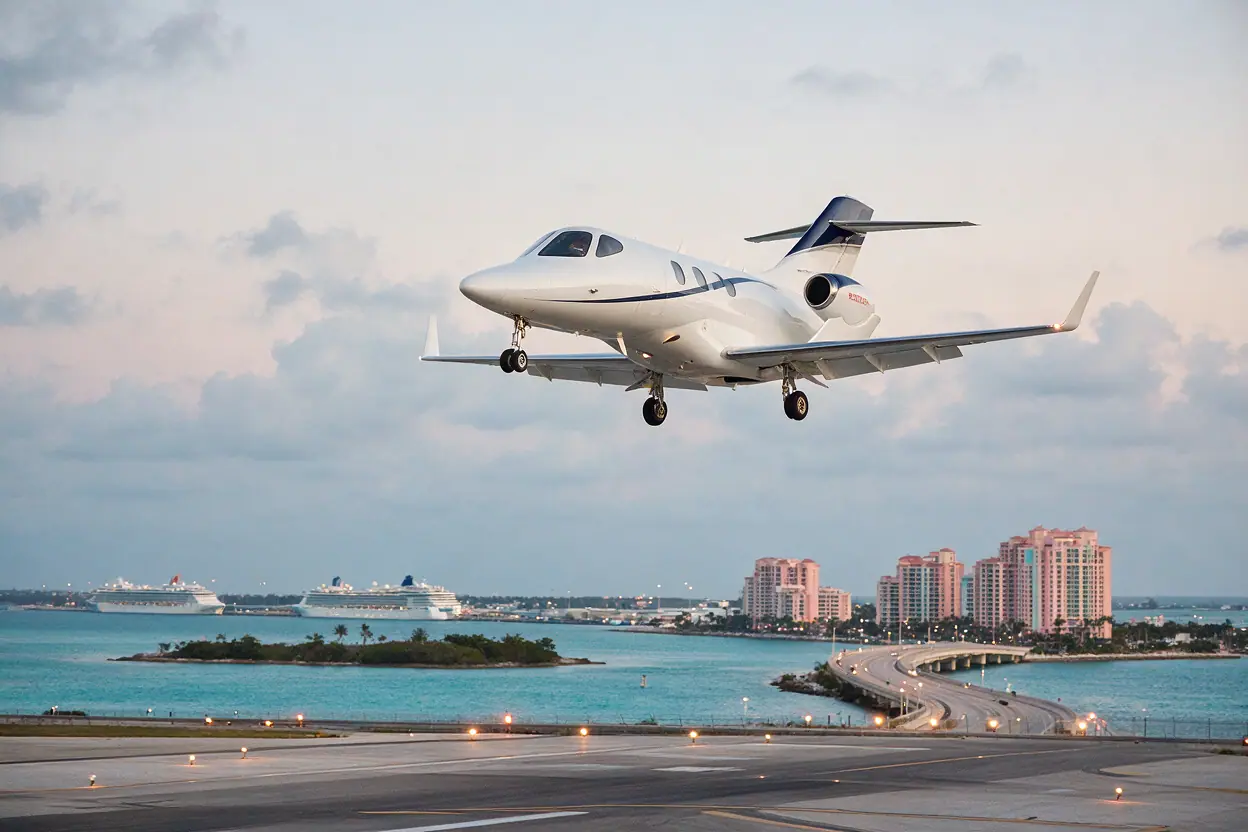
Across these 6 private jet routes, distance spans 199 to 2,129 nautical miles; one-way light jet estimates range from $4,000 to $36,000.



Inquiries on this airfield
What do private jet rental prices Harry Reid travelers see typically include?
A quote for private jet rental prices Harry Reid routes includes aircraft, crew, fuel and airport fees, and we arrange it as your agent under DOT Part 295. The operator flying your trip holds FAA Part 135 authority and keeps operational control. Ask for an itemized breakdown so ramp fees at Atlantic Aviation or Signature Aviation, plus any after-hours charge, appear as separate lines instead of one lump sum.
How far is Harry Reid from the Las Vegas Strip?
The airport is about 2 miles from the Strip, so the transfer after landing is short. That proximity keeps ground costs and crew duty time lower than at outlying fields. If your schedule is tight, then the 2-mile ride means you can land and reach a resort corridor meeting without a long highway run, which matters when you compare quotes across airports.
Does heat affect charter flights out of Harry Reid in summer?
Yes. July averages a 105F high with density altitude near 5,800 feet, and the field can reach about 6,300 feet at 115F. Thin air reduces lift, so operators may trim payload or fuel. If you fly in midsummer, then plan for possible weight limits and book earlier, because peak event weeks tighten aircraft availability and move quote levels.
Which runway do private jets use at Harry Reid?
The longest runway measures 14,835 feet at 2,181 feet elevation, which is enough for heavy jets departing nonstop to distant cities. That length supports transcontinental legs such as Teterboro at 2,227 miles and Miami-Opa Locka at 2,170 miles. Shorter hops to Van Nuys, 229 miles out, are routine for light and midsize aircraft.
What FBOs serve private jets at Harry Reid?
Atlantic Aviation and Signature Aviation are the two FBOs listed for general aviation at the field. Which one handles your flight depends on the operator's arrangements, and we confirm it at booking. Ground handling and ramp fees differ by facility, so request the itemized charges. If your trip is international, then CBP processing at this port of entry adds time to the schedule.
How do route distances change private jet rental prices Harry Reid quotes?
Distance sets the aircraft class. Van Nuys at 229 miles suits light jets and turboprops, while Teterboro at 2,227 miles and Miami-Opa Locka at 2,170 miles call for midsize or heavy aircraft with longer legs. Longer routes mean more fuel, more crew duty time and higher quotes. Empty leg flights occasionally cut cost when an aircraft repositions, but availability is unpredictable.