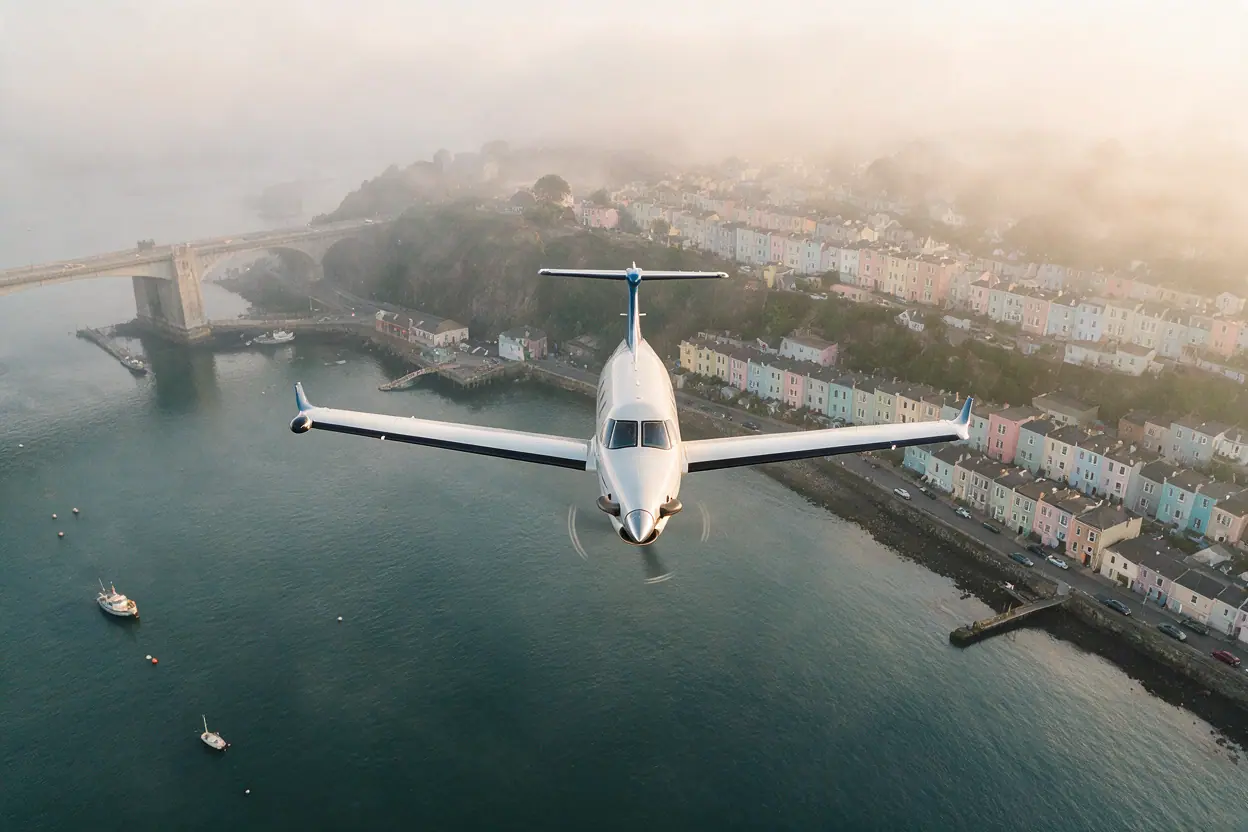
Private jet rental prices Los Angeles to San Francisco
Private jet rental prices Los Angeles to San Francisco are estimates that start near $3,000. The 279-nautical-mile route favors a turboprop over faster, pricier jets. This page breaks down the figures by class, airport and timing.
- 279 nm321 statute miles
- 1h 17mturboprop flight time
- $3,000–$4,500one-way estimate
Los Angeles to San Francisco private jet prices by aircraft
Flying private from Los Angeles to San Francisco spans 279 nautical miles, takes 1h 17m on a turboprop, and is estimated at $3,000–$4,500 one way.The table below estimates one-way charter prices for the Los Angeles to San Francisco route by aircraft class. Figures are broad ranges, not quotes, and they move with fuel, crew duty time, airport fees and how far in advance you book. Use them to compare classes, then request a firm quote for your dates.
| Aircraft class | Time en route | Estimated one-way | Notes |
|---|---|---|---|
| Turboprop | 1h 17m | $3,000–$4,500 | Best fit |
| Light jet | 0h 59m | $4,000–$6,000 | Nonstop |
| Midsize jet | 0h 58m | $5,000–$8,000 | Nonstop |
| Super-midsize jet | 0h 55m | $7,000–$10,000 | Nonstop |
| Heavy jet | 0h 55m | $9,500–$14,500 | Nonstop |
Figures are per aircraft, not per seat, excluding federal excise tax and segment fees. Block time covers taxi, climb and descent.
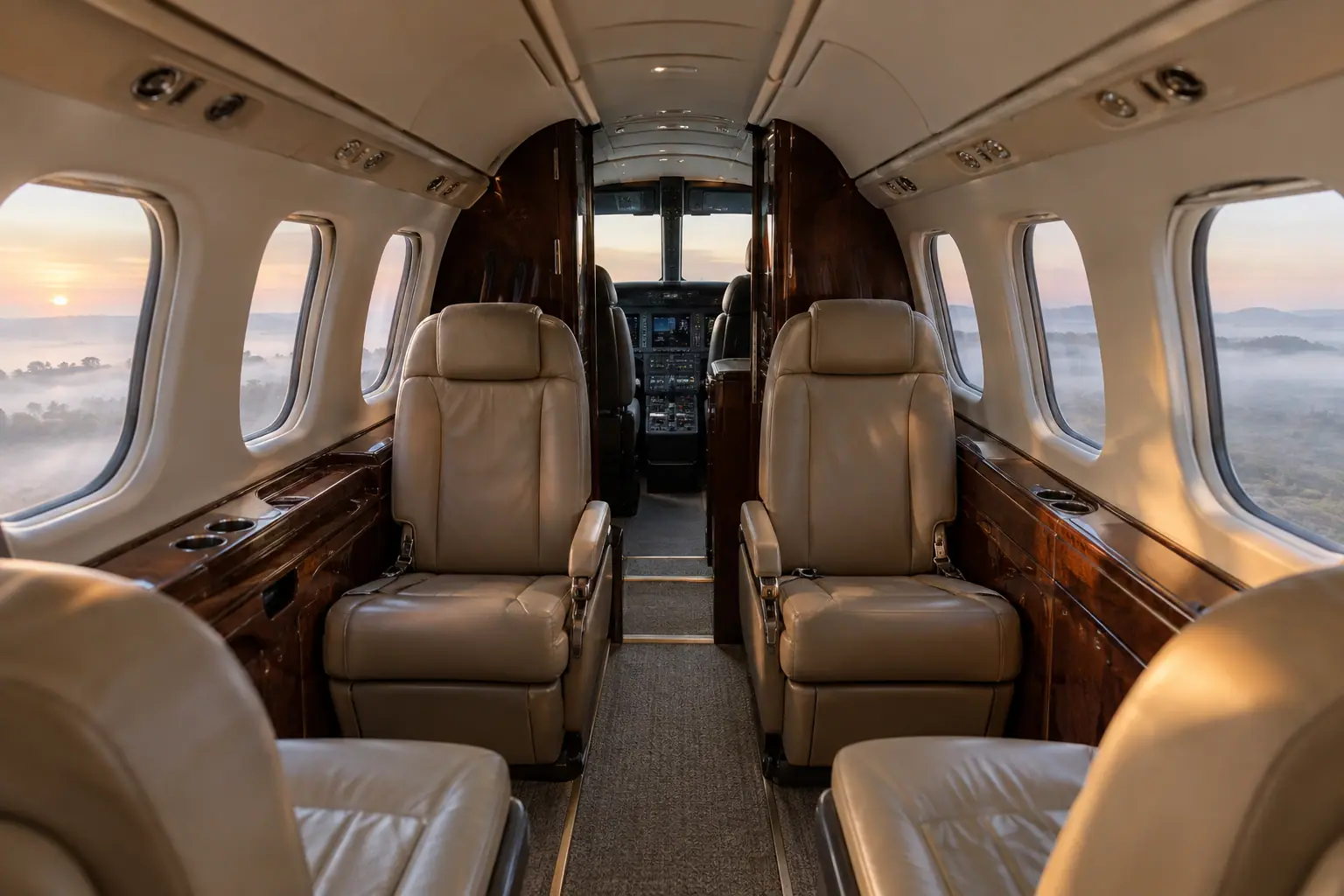
Why a turboprop fits this trip
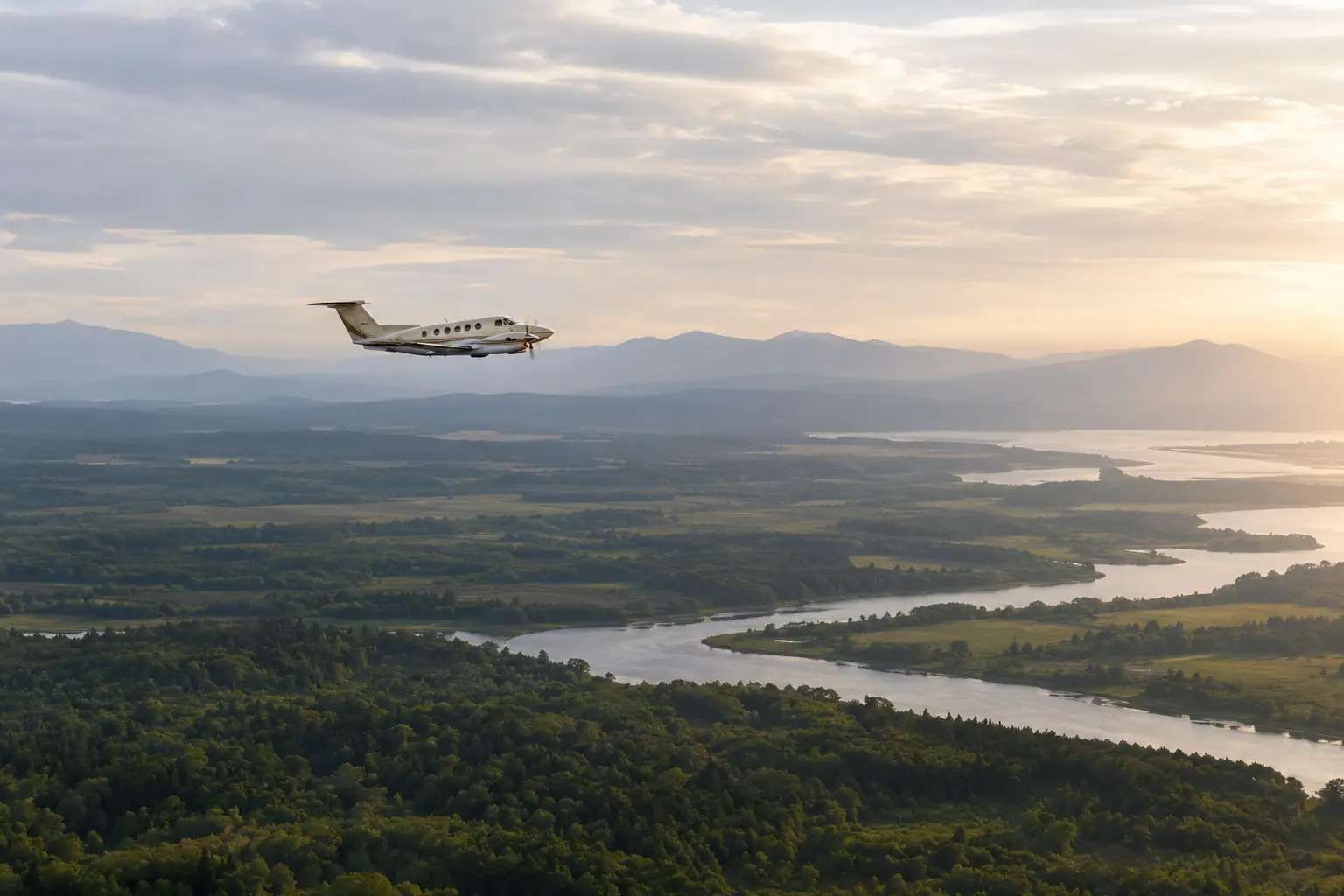
For 279 nautical miles, the turboprop is the class that fits the mission. A Beechcraft King Air 350i or Pilatus PC-12 NGX covers the distance nonstop in about 1 hour 17 minutes at an estimated $3,000 to $4,500 one way. A turboprop carries six to eight passengers at the lowest price on this 279 nm route. It climbs and descends efficiently on a short sector, so you are not paying for jet speed you barely use. If your schedule is tight, a light jet at $4,000 to $6,000 cuts the flight to 59 minutes.
The light jet and midsize jet bracket the turboprop on price and time. A light jet flies the route in 59 minutes for an estimated $4,000 to $6,000, and a midsize jet does it in 58 minutes for $5,000 to $8,000. If you need more cabin height or baggage space, then the midsize jet at $5,000 to $8,000 is the step up. Super-midsize and heavy jets are also available at $7,000 to $14,500, but on a 55-minute sector most of that capability goes unused. For Los Angeles to San Francisco, the turboprop is the value pick among the five classes.
Pilatus PC-12 NGX
- 6 seats
- 290 kt cruise
- 1,800 nm range
Cabin 4 ft 10 in tall, 16 ft 11 in long. Baggage 40 cu ft.
Daher TBM 960
- 6 seats
- 330 kt cruise
- 1,730 nm range
Cabin 4 ft tall, 13 ft 3 in long. Baggage 32 cu ft.
Departing from the Los Angeles area
On the Los Angeles end, the three main departure points are Van Nuys Airport (KVNY) with an 8,001-foot runway, Hollywood Burbank (KBUR) at 6,886 feet, and Los Angeles International (KLAX) at 12,894 feet. Van Nuys is the busiest general aviation field in the Los Angeles basin for short hops north. Where you start depends on where you live and which operator has a turboprop positioned nearby.
Private flights leave from FBOs and general aviation terminals, not the main commercial concourses, so you avoid the check-in and security lines at LAX. If your group starts near Burbank, then KBUR can trim ground time versus driving to Van Nuys. Your broker confirms the FBO and arrival instructions once the operator is assigned.
Arriving in San Francisco
At the San Francisco end, the two practical arrival airports are San Francisco International (KSFO) with an 11,870-foot runway and Oakland San Francisco Bay (KOAK) at 10,520 feet. Oakland often gives faster access to the East Bay and less ground congestion than SFO. Both fields sit close to the urban core, so the last leg of the trip is short.
From either airport, downtown San Francisco is a brief drive, and the Peninsula and Silicon Valley are reachable without a long transfer. If your meetings are in the Financial District, then SFO puts you closest to the bridge approach. Your operator handles the arrival slot and ground handling; your broker passes along the FBO details.
| Airport | Code | Runway |
|---|---|---|
| San Francisco International Airport | KSFO / SFO | 11,870 ft |
| Oakland San Francisco Bay Airport | KOAK / OAK | 10,520 ft |
| Van Nuys Airport | KVNY / VNY | 8,001 ft |
| Hollywood Burbank/Bob Hope Airport | KBUR / BUR | 6,886 ft |
| Los Angeles International Airport | KLAX / LAX | 12,894 ft |
When prices peak on this route
Demand on Los Angeles to San Francisco climbs during weekday morning and evening peaks, when business travelers move between the two metros, and again around major Bay Area events and conventions. Booking three to seven days ahead usually widens the choice of turboprops and light jets at the lower end of the range. Same-day requests narrow the pool and tend to price toward the top of each band.
Weekends and holiday periods also tighten availability, especially for the six- to eight-seat turboprops that suit this distance. If you need a same-day round trip, then plan for crew duty limits that can raise the price above a simple one-way estimate. Ask your broker to price the return leg at the same time so the operator can keep the aircraft on the ground briefly instead of repositioning.
Private jet routes similar to Los Angeles to San Francisco
Across these 6 private jet routes, distance spans 82 to 208 nautical miles; one-way turboprop estimates range from $2,000 to $3,500.
Inquiries on this city pair
What are typical private jet rental prices Los Angeles to San Francisco?
Estimates run about $3,000 to $4,500 for a turboprop, $4,000 to $6,000 for a light jet, $5,000 to $8,000 for a midsize jet, $7,000 to $10,000 for a super-midsize jet and $9,500 to $14,500 for a heavy jet. These are one-way ranges, not quotes. They move with date, demand and how much aircraft is available in the Los Angeles basin on your day.
How long is the flight from Los Angeles to San Francisco by private jet?
The route covers 279 nautical miles, or 321 statute miles. A turboprop covers it in about 1 hour 17 minutes, a light jet in 59 minutes, a midsize jet in 58 minutes, and both super-midsize and heavy jets in 55 minutes. Every class flies nonstop. The gap between the slowest and fastest aircraft is about 22 minutes, while the price gap is far wider.
Which aircraft class is best for this short route?
The turboprop is the best fit at 279 nautical miles. A Beechcraft King Air 350i seats up to 8 passengers and a Pilatus PC-12 NGX seats 6, both with ranges well beyond this sector. At an estimated $3,000 to $4,500 one way, the turboprop undercuts the light jet at $4,000 to $6,000 while adding roughly 18 minutes to the flight.
Which airports serve private flights from Los Angeles to San Francisco?
On the Los Angeles side, Van Nuys (KVNY, 8,001-foot runway), Hollywood Burbank (KBUR, 6,886 feet) and Los Angeles International (KLAX, 12,894 feet) are the main options. In the Bay Area, San Francisco International (KSFO, 11,870 feet) and Oakland (KOAK, 10,520 feet) handle most arrivals. Your broker matches the departure field to where you live and the arrival field to your destination.
Can I book a same-day round trip between Los Angeles and San Francisco?
A same-day round trip is practical given the 55- to 77-minute flight times, but crew duty limits and aircraft positioning affect the price. Expect the round trip to cost more than double a one-way estimate if the aircraft must wait on the ground or reposition. Booking a few days ahead gives the operator more flexibility and usually lowers the total.
Who operates the flight and who arranges it?
Flights are flown by independent companies that hold FAA Part 135 authority, so the operator, not the broker, holds operational control. The broker arranges the trip as an agent under DOT Part 295 rules. This route stays inside California, so no CBP processing applies, and private terminals do not put you through the TSA screening used at commercial concourses.