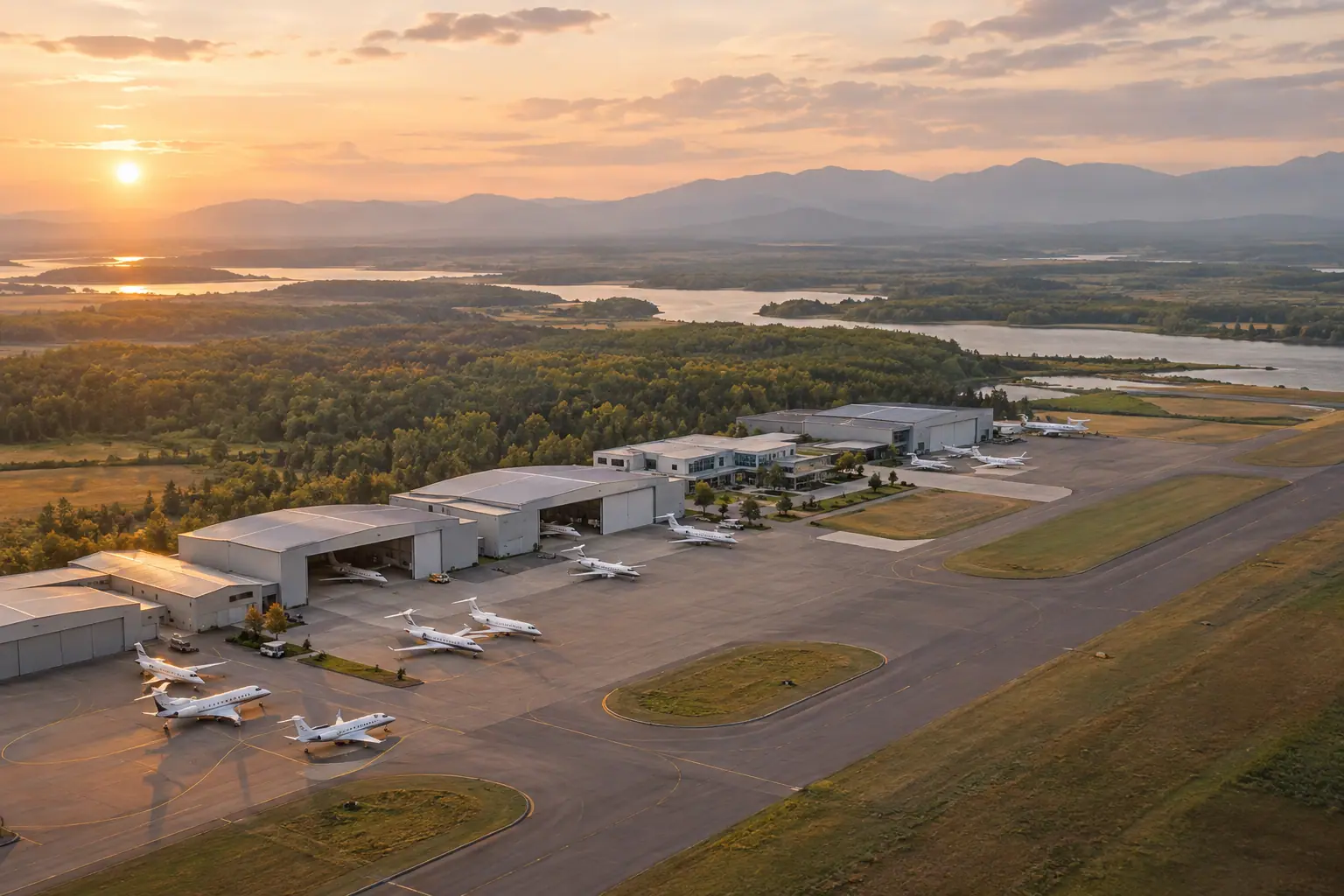
Private jet rental prices King County Boeing Field
Private jet rental prices King County Boeing Field are quoted per trip, not per mile. The field sits 21 ft up with a 10,007 ft runway. Broker estimates are ranges, and operators confirm the final figure.
- KBFI · BFIIATA codes
- 21 ftairport altitude
- 10,007 ftlongest runway
- 0 mito New York
Private jet rental prices King County Boeing Field start with the field itself: King County International Airport, coded BFI and KBFI, sits 21 ft above sea level and runs a 10,007 ft main runway, numbers that let heavy jets depart without payload limits. Boeing Field's 10,007 ft runway keeps light jets and heavy jets on the same departure calculus. That matters because aircraft size, not runway length, usually sets the price on a Seattle booking.
The airport is publicly owned and sits a few miles south of downtown Seattle, which is why it carries both airline and business traffic. King County Boeing Field handles charter flights alongside Boeing test and delivery movements. Brokers arrange the trip; the flying is done by operators holding FAA Part 135 authority, and they keep operational control of every leg. A broker acting as your agent falls under DOT Part 295 rules, which is why the quote you sign and the operator flying it can be separate companies.
Pricing runs on three inputs: aircraft class, crew duty time, and how long the jet sits waiting at BFI. A turboprop or light jet on a short Pacific Northwest hop costs a fraction of a super-midsize crossing the country. Private jet charter cost at BFI climbs fastest when crew time and overnight parking are added. Ask for the quote broken into flight time, ground time and fees so the comparison is honest. If a quote arrives as a single number, then ask which of those three inputs is bundled inside it.
Runway length and density altitude
BFI's longest runway measures 10,007 ft at an elevation of 21 ft, so density altitude rarely limits a charter departure and most jets can leave at or near maximum takeoff weight. A 10,007 ft runway at 21 ft elevation removes most performance limits at Boeing Field. Summer afternoons lift July density altitude to about 1,200 ft; even a 115F day reaches only about 1,800 ft. That is a mild number next to mountain airports, and it means operators rarely need to offload fuel or passengers to get out of Seattle. If you are flying a heavy jet west toward Asia, then the long runway is the reason the fuel load stays intact.
| Runway | Size | Width | Surface |
|---|---|---|---|
| 14R/32L | 10,007 ft | 200 ft | Asphalt |
| 14L/32R | 3,709 ft | 100 ft | Asphalt |
FBOs and ground handling at BFI
Four handlers work the field: Modern Aviation, Signature Aviation, Skyservice Seattle and Vesper Aviation, so a charter can usually be parked and serviced without a long taxi wait. Modern Aviation, Signature Aviation, Skyservice Seattle and Vesper Aviation handle charter arrivals at BFI. Each sets its own ramp and handling fees, which show up in the quote as a line item rather than inside the hourly rate.
Which one your operator uses is a scheduling decision, not a price signal. If you have a preference, say so when you request the quote and the broker can route the request to operators based there.
What BFI is best for
- Pacific Northwest business trips into downtown Seattle, Bellevue and Tacoma
- Tech and aerospace visitors who want a field south of the city center
- West Coast routes to the Bay Area, Los Angeles and Southern California
- Winter departures where cold, dense air allows full-fuel heavy jet takeoffs
| Class | Runway required | Here |
|---|---|---|
| Turboprop | 3,300 ft+ | Fits |
| Light jet | 4,000 ft+ | Fits |
| Midsize jet | 5,000 ft+ | Fits |
| Super-midsize jet | 5,200 ft+ | Fits |
| Heavy jet | 5,600 ft+ | Fits |
Density altitude at BFI by season
July and August highs average 77F with density altitude near 1,200 ft, while December averages 45F and drops density altitude to about -900 ft, a swing that favors winter departures for heavy loads. Seattle's wet season runs from November through January, when BFI sees 18 to 19 wet days a month. That is the period most likely to produce a weather delay or an alternate plan, not a performance problem.
Spring and fall sit in between: April and October each bring about 15 wet days with density altitude close to sea level. Summer is the cleanest window at 3 wet days in July, though morning marine cloud can slow the first departures of the day. If your schedule is tight, then a July morning slot beats a November afternoon almost every year.
| Monthly | Avg high | Wet days | Alt. density |
|---|---|---|---|
| Jan | 47°F | 17 | -800 ft |
| Feb | 47°F | 17 | -800 ft |
| Mar | 52°F | 15 | -400 ft |
| Apr | 57°F | 15 | -100 ft |
| May | 64°F | 10 | 400 ft |
| Jun | 70°F | 9 | 800 ft |
| Jul | 77°F | 3 | 1,200 ft |
| Aug | 77°F | 5 | 1,200 ft |
| Sep | 69°F | 11 | 700 ft |
| Oct | 60°F | 15 | 100 ft |
| Nov | 50°F | 18 | -600 ft |
| Dec | 45°F | 19 | -900 ft |
Getting to and from the airport
BFI sits a short drive south of downtown Seattle, close to Interstate 5 and State Route 99, which puts most of the city within a straightforward car ride. King County Boeing Field is the closest jet-capable field to downtown Seattle and the stadium district. Traffic on I-5 is the variable; build slack into a departure if you are crossing the city at rush hour. Return legs on international routes clear through CBP, and operators file passenger manifests in advance under TSA rules.
Private jet routes via King - Boeing
Across these 6 private jet routes, distance spans 199 to 2,129 nautical miles; one-way light jet estimates range from $4,000 to $36,000.
Inquiries on this airfield
What do private jet rental prices King County Boeing Field look like by aircraft class?
Expect a light jet to price below a midsize, and a midsize below a super-midsize, on the same city pair. The gap comes from cruise speed, cabin size and hourly operating cost, not from BFI itself. Because the field is 21 ft above sea level with a 10,007 ft runway, no class pays a payload penalty. Treat every figure as a broker estimate until an FAA Part 135 operator confirms it in writing.
Does density altitude ever limit departures from BFI?
Rarely. July density altitude at BFI averages about 1,200 ft, and even a 115F peak day reaches only about 1,800 ft. With a 10,007 ft runway and 21 ft field elevation, operators almost never need to shed fuel or passengers. Compare that to Centennial outside Denver, where peak density altitude runs near 9,600 ft, and the difference in departure planning is obvious.
How far is the flight from BFI to Van Nuys?
The airport-to-airport distance is about 869 miles, a routine leg for a light jet or turboprop and a short hop for a midsize. Block time depends on winds and routing, and the quote should show flight time separately from ground and handling fees. Van Nuys sits at 802 ft elevation with an 8,001 ft runway, so the arrival is unrestricted for the same aircraft.
Which FBOs handle charter aircraft at Boeing Field?
Four: Modern Aviation, Signature Aviation, Skyservice Seattle and Vesper Aviation. Each publishes its own ramp and handling charges, and those fees appear as separate quote lines rather than inside the hourly rate. Ask the broker which handler the operator plans to use so you can compare quotes on equal terms. Ground time beyond the scheduled window is usually billed by the hour.
When is the wettest time to schedule a charter out of BFI?
November through January, when BFI averages 18 to 19 wet days per month and highs sit near 45 to 50F. Those months carry the highest odds of a weather delay, though density altitude drops to about -900 ft and performance improves. July is the driest month at 3 wet days, which makes it the most reliable window for a tight schedule.
Who is responsible for the flight when I book through a broker?
The operator flying the trip holds FAA Part 135 authority and keeps operational control, including the decision to launch or divert. A broker arranging the flight acts as your agent under DOT Part 295 and does not own the aircraft. On international legs, CBP clears the arrival, and TSA manifest rules apply. Get the operator's name in writing before you pay a deposit.